Space tourism is an old idea. The first waiting lists
for commercial trips to the Moon have been around for
almost fifty years now.(1) The first scientific study on
the subject was done by the late Krafft Ehricke in 1967.(2) But only in the
1990s, when the Cold War was over and government space
programs started to run into problems, experts started
to look into space tourism in earnest. The first serious
market studies, involving a survey of potential
customers, were done under the auspices of the Japanese Rocket Society in 1993.(3)
in 1967.(2) But only in the
1990s, when the Cold War was over and government space
programs started to run into problems, experts started
to look into space tourism in earnest. The first serious
market studies, involving a survey of potential
customers, were done under the auspices of the Japanese Rocket Society in 1993.(3)
The results for Japan were so positive that they
motivated surveys in other countries like the USA,
Germany and Canada. Even NASA, still the space agency,
confirmed in writing that there is enough demand for
space tourism to make it commercially feasible.(4)
The following gives a brief overview of the key
findings in several studies (all numbers referring to
flights into Low Earth Orbit):
Japanese Rocket
Society study (1993)(5)
- 1,000,000 space tourists per year in Japan
- Annual turnover of $14 billion for ticket prices
of $14,000 (all $ in 1995 values)
Daimler-Benz Aerospace business plan for RLV (1995)(6)
- 450,000 space tourists per year in Europe
- Annual turnover of $20 billion for ticket prices
of under $50,000
NASA/STA study (1997)(7)
- $1020 billion per year "general public
spacetravel and tourism" business
TU Berlin study (1997/98)(8)
- 100,000 space tourists per year globally
- Annual turnover of $9 billion for ticket prices
design (Fig. 1), reference concept of the of under
$100,000
While all these demand figures look quite high,
maybe even too optimistic, the core question remains:
How are all these people going to fly into space?
The Failure of
Government Space Programs
Although the required technology exists,
governments have miserably failed for the last decades
to give the average tax payer access to space. Even
after having spent trillions of dollars on government
space activities, space still remains to be the domain
of some happy few, government-paid astronauts.
Today, there simply is no such thing as a
passenger-rated space launch system for tourism
applications. The US Space Shuttle, which is the
closest it gets today to having an airliner-type space
transport vehicle, is far too expensive for commercial
passenger transportation to orbit. Depending on the
way one accounts for the Shuttle's R&D
depreciation, a ticket can cost up to $100 million.
But even if somebody was willing to pay so much, he
or she would not be allowed to fly, since NASA officially ruled out the
Shuttle for space tourism in 1985.(9) In that context,
it does not help very much that the Russians currently
offer Soyuz flights to Mir for $1020 million.
Despite the recent hype about the upcoming Dennis Tito flight(10), selling
surplus transport capacity on government-funded space
infrastructure seems not to be a viable business model
for the future.
For some years, there still was hope that the
government is at least going to pay for some reusable
launch vehicle. Many such designs have been proposed
over the years, for instance the Shuttle II, Delta
Clipper (USA), Hotol (UK), Radiance (France),
just to name a few. Given the possibility of having an
economically viable system available soon, a lot of
research was done in the field of defining additional,
tourism-like applications for future space launch
vehicles. Especially the German SÄNGER German
hypersonics technology program(11), was subject to
several studies of its space tourism potential, some
of them very detailed in terms of ticket cost.(12)
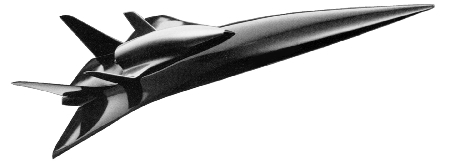
Fig. 1: SÄNGER launch system(13)
Typically, the rough business plans laid out in
those studies assumed that the government is going to
pay for R&D of the respective vehicle. The space
tour operator just had to buy a fleet of vehicles
(some spaceplanes, for instance), set up the
infrastructure, open a spaceport and start to fly
tourists. In the financing models of these optimistic,
government-confident scenarios, there was not much
emphasis on the cost of capital. Usually rates around
6% were assumed, as in other big public sector
projects. At least, government was expected to pay the
hefty R&D bill and after that the operational
system would be available for doing business.
Unfortunately, it did not work out that way. SÄNGER
was more or less terminated in 1995 and so were almost
all the other government-funded launcher projects. It
became quite obvious that the kind of space launch
vehicles that is required to achieve affordable space
transportation "for the rest of us" is not going to be
paid for by government space programs.
So, it is now the turn of the private sector to
finally open up space for the public.
A Typical
Private Sector Venture in Space Tourism
Some of the most detailed and thoroughly researched
scenarios of a private space tourism venture are those
developed at the Technical
University of Berlin in 1997/98.(14) They all
relied on using the Japanese Kankoh-Maru rocket - developed by
Kawasaki Heavy Industries (see Fig.
2) - for flying space tourists to LEO (Low Earth Orbit) and
back.(15)
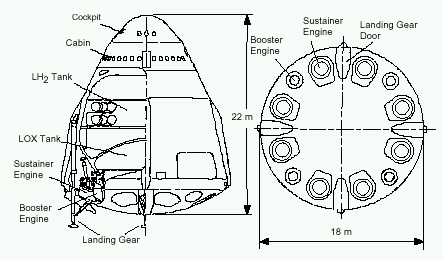
Fig. 2: Kankoh-Maru rocket for 50
passengers(16)
A number of different market scenarios was analyzed
and the findings were documented in several reports.
One, the so-called "reference scenario" can be used as
an example for demonstrating some financial key
parameters ($ in 1998 values):
- 100% privately funded
- Investment: $7,800 million
- Required rate of return: 6% per year (equal to
government-backed loan)
- Max. capacity: 100,000 passengers per year to
LEO
- Ticket price: $50,000 (average)
This reference scenario as a typical case study
justifies investing in space tourism by quoting a
short-enough Payback Period and a sufficient Return on
Investment (ROI). The following figures are quoted
from the presentation of the reference scenario at the
ISST '97(17):
- Payback Period: 17 years
- ROI after 20 years: 16.6%
- ROI after 50 years: 31.7%
The interesting thing about this scenario, which
has been widely communicated in the space tourism
community, is that it assumes the same cost of capital
as for government-backed loans. The big question here
is whether this is a realistic assumption for the
yet-to-be-proven business of space tourism. Probably
not.
The Problems
of Private Rocket Companies
During the 1990s many startup companies have been
established in the field of space transportation
vehicles. Some of them explicitly quoted space tourism
as a major revenue stream for their intended
businesses. A brief scan of space-related sites on the
Internet delivers the following company names(18):
While some of these companies have been able to
raise a large amount of private capital (particularly
Kistler and Rotary), most of their
competitors are still cash-starved and seeking equity
funding for their projects. "The biggest challenge for
us is raising capital, plain and simple," says Bob
Davis, CEO of Kelly. So, it seems to be very
hard to get funding for rocket ventures.(19)
No Bucks, No
Buck Rogers
Although the existing market studies look very
promising, private capital seems to be hard to get for
a full-blown space tourism venture.
Why is this so?
For obvious reasons, it is hard to get insight into
the business plans of all these ventures, so we will
have to rely on assumptions here:
It is very likely that many finance people still
perceive the space sector as being stuck with the old
"high cost/high performance paradigm" of the Apollo
days. Back then, technological merit was all what
counted; economic performance was secondary. For forty
years, private capital was not a big issue in the "old
rocket economy". All the big projects were
government-funded.
Many rocket scientists have yet to learn to sell
their technology by demonstrating its profitability.
Therefore, in view of lacking investor response, a
hypothesis of missing proof comes to mind:
To the capital markets, it is still unproven
whether space tourism is profitable and potential
investors are waiting for proof. Obviously, Payback
Period and ROI as in the Kankoh-Maru example are not sufficient
as good investment criteria. So, what is wrong with
payback period and return on investment?
The Payback period is not such a good investment
criterion, because:
- Payback gives equal weight to all cash flows
before payback date, no weight at all to subsequent
flows
- Projects that are equally attractive in terms of
payback may have widely differing overall
performance
- The choice of cutoff period often relies on pure
guesswork
Return on investment (ROI) is a better choice
criterion, but still not good enough, because it might
pretend too optimistic results. The ROI calculation is
based on book costs and therefore contains, for
example, depreciation: depreciation stretches costs
over a long period and hence does not reflect economic
reality. Thus, there need to be better criteria for
investment decisions.
The Advent of
Rocket Finance
The space tourism business has to be described in a
language that is understandable to the capital
markets. According to the school of thought in
corporate finance the two really significant terms for
investors are those of Net Present Value and Cost of
Capital.(20)
Net Present Value (NPV):
The net present value rule says that one
only accepts investments that have positive net
present values.
Cost of Capital (r):
The rate-of-return rule says that one only
accepts investments that offer rates of return in
excess of their opportunity costs of capital.
The key features of Net Present Value (NPV) make it
so important as an investment criterion:
- Recognizes the time value of money ("one dollar
today is worth more than a dollar tomorrow")
- Depends solely on forecasted cash flows and on
the opportunity cost of capital (independent from
accounting rules; "depends only on cash")
- Any attempt to make up NPVs comes down to a
change in basic assumptions (like distribution of
revenues or cash costs)
The formula for the NPV is:
NPV = C0 + C1/(1+r) + C2/(1+r)2 + ... + CT/(1+r)T
- C0
- Initial investment (= negative cash flow)
- Ct
- Cash flow of the respective year
- r
- Opportunity cost of capital
- T
- Number of years Return on investment (ROI) is
a better
Thus, in order to calculate an NPV, one needs the
cost of capital. The cost of capital accounts for the
intrinsic risk of future revenue streams, therefore it
adds a new quality of information that is not present
when just talking about payback and ROI.
The more revenue predictions reach into the future,
the more difficult they become:
- the revenue risk varies by industry (volatile
vs. mature industries)
- the annual discount percentage (1/(1+r)t) is a reward to
investors and compensates them for uncertainty in
future revenues
The capital market is primarily interested in
ventures that return more than their cost of capital.
Usually the cost of capital is modeled by applying the
CAPM (Capital Asset Pricing Model).
According to the CAPM, the cost of capital for a
risky investment is:
r = rf +  (rm - rf)
- r
- Cost of capital
- rf
- Risk-free interest rate (Treasury bills;
around 3.8%)(21)
- rm
- Expected rate of return on the market
portfolio (S& P 500; around 13%)(22)
-
- Measure for business risk ("Beta")
In order to quantify the cost of capital for space
tourism, the business risk index (Beta) has to be
known.
The "Beta" describes the average volatility of
individual stocks or other assets relative to the
market as a whole (S&
P 500's Beta = 1.0) over
some specified period of time.
The Beta formula goes as follows:
asset = debt ×
(Debt/Capital)
+ equity ×
(Equity/Capital)
For the ease of calculation, 100% equity of capital
were assumed (asset = equity).
But: how to derive a Beta for a still non-existent
industry like space tourism?
There are several methods for determining a Beta
(Tab. 1). But in the case of space tourism, the
comparables method is the only appropriate one,
because up to now, historic data is not available.
|
| Which method |
How it works |
When to apply |
|
| Use Beta book |
Look up beta values in reference book |
Firm/industry quoted in beta book
Firm/industry exists for at least two
years |
|
| Regression analysis |
Analyze stock performace in comparison to
S& P 500 |
Firm quoted on stock exchange
Historic data available |
|
| Comparables method |
Analyze betas of similar firms and/or
industries |
Firm and/or industry does not exist
yet |
|
Tab. 1: Different methods for
determining Betas
A comparable industry for estimating a Beta has to
have similar characteristics to space tourism. That
prospective industry is characterized by:
- Product (mostly intangible: experience, thrill,
high tech, not an investment)
- Quantity (rather low, luxury)
- Customer Segment (rich people)
- Purchasing Patterns (once-in-a-lifetime)
- Company Position in the value chain (design;
build; operate; promote)
The following industries which have similar
characteristics come to mind:
- Recreational Activities (especially cruise
lines)
- Luxury Apparel & Accessories
- Wedding Party Services
The Betas of all these existing industries (or of
single companies) can be looked up conveniently in the
respective sources for evaluation.(23)
Space
Tourism's Opportunity Cost of Capital
The estimated Beta (see Tab. 2) for space tourism
indicates a relatively high volatility of the
respective cash flows, because, according to the CAPM,
the resulting cost of capital for a space tourism
venture is:
|
| Industry/Company (Ticker Symbol) |
Beta* |
Comparability |
|
| Recreational Activities |
1.30** |
good |
| Carnival Corporation (CCL) |
1.26 |
very good |
| Europa Cruises Corp. (KRUZ)
|
1.34 |
very good |
| Royal Olympic Cruise Lines
(ROCLF) |
1.29 |
very good |
| Royal Carribean Cruises (RCL)
|
2.06 |
very good |
| Luxury Apparel & Accessories |
1.55** |
fair |
| Donna Karan (DK) |
1.21 |
fair |
| Gucci Group (GUC) |
1.50 |
fair |
| LVMH (LVMHY) |
1.89 |
fair |
| Wedding Party Services |
N/A |
-- |
| N/A |
-- |
-- |
|
| Estimated Beta for Space Tourism |
1.50 |
|
*)
Relevered Betas; all equity, no debt (Source:
Ibbotson.com, Multex.com)
**) Industry Beta
Tab. 2: Determining the space tourism
industry Beta with the comparables method
Even seen over a period of 50 years, this orbital
space tour venture still has a negative NPV of almost
$3 billion! With the government-backed credit at 6%
per year, as initially assumed, the venture would at
least have a positive NPV after year 20, but the
internal rate of return with only 10.7% is relatively
low (see Appendix).
r = rf + (rm - rf)
r = 3.8% + 1.5(13% 3.8%)
r = 17.6%
assuming all-equity financing, no debt.
Obviously, a typical space tourism venture has to
return 17.6% per year, otherwise it won't be a good
investment. If this figure is now applied to the
calculation of the Net Present Value of the
aforementioned business case with the Kankoh-Maru rocket (for complete NPVs,
see Appendix),
it becomes obvious that it won't be a good
investment:
- NPV over 10 years: -4,781 million ('98$)
- NPV over 20 years: -3,553 million ('98$)
- NPV over 50 years: -2,993 million ('98$)
These rather surprising results ask for a
sensitivity analysis. Higher leverage, that is:
increasing the share of debt financing, can help to
increase long-term NPV. In a theoretical exercise that
can be seen in the following table, a total
Debt/Equity ratio of 10 (equals a Debt/Value ratio of
90%) brings the cost of capital close to the 6% as
initially assumed in the Kankoh
Maru scenario (see Tab. 3).
|
| Debt/Value |
assets* |
r |
NPV10[$ M]** |
NPV20[$ M] |
NPV50[$ M] |
|
| 0% |
1.5 |
17.6% |
-4,781 |
-3,553 |
-2,993 |
| 50% |
0.8 |
11.16% |
-5,549 |
-2,736 |
-378 |
| 75% |
0.45 |
7.94% |
-6,024 |
-1,651 |
3,571 |
| 90% |
0.24 |
6.01% |
-6,345 |
-596 |
8,080 |
| 95% |
0.17 |
5.36% |
-6,461 |
-145 |
10,209 |
| 99% |
0.11 |
4.85% |
-6,554 |
248 |
12,170 |
|
*) debt = 0.1;
**) Index gives number of years (NPV10 = NPV over 10 years etc)
Tab. 3: NPVs with increasing financial
leverage
In these simple calculations, the cost of capital
drops as financial leverage increases. But this
overstates the advantages of debt. For example, costs
of financial distress encountered at high debt levels
have not been taken into account; in reality they
would affect the cost of equity, because a firm with a
debt level of 99% would be virtually bankrupt.
Lessons
Learned
We can learn from this that space tourism ventures
- at least those planning to fly into orbit, thus
needing billions of dollars - will require
professional business plans and sophisticated
financial models to make them commercially feasible.
Especially the optimization of the debt to equity
structure promises to become a rather complex task,
since a pure equity investment does not provide
positive returns in a typical $7.8 billion LEO tourism project.
The major problem which has such a negative impact
on the project's NPV is the long time for R&D (7
years) and the high initial investment.
So, it may be asked: Why do space tourism projects
have to be so big? In recent years, many small firms
have been emphasizing that it is much more attractive
to start with suborbital space tourism, because:
- The required technology is much less complex
- The ticket costs are much lower
- The up-front investments are more in the range
of millions, not billions
- There is an X-Prize of $10 million waiting
to be won(24)
While preparing this paper, the authors conducted a
financial study of a typical X-Prize vehicle, a small
spaceplane with up to four seats.(25) As can be seen
from the NPV calculation in the Appendix,
small really means beautiful in this context:
- NPV over 10 years: 13.22 million ('98$)
- Investment needed: 45 million (`98$)
Even the high cost of capital of 17.6% does not
have an overly negative impact, because the project
performs with an Internal Rate of Return (IRR) of 28%
(over 10 years). These are indeed very positive
prospects for suborbital tourism as a viable first
step towards public space travel!
Conclusion
The typical annual rate of return so often used
before in the financial modeling of space tourism
(around 6%) is not realistic, because such a rate can
only be achieved with a government-backed loan. The
latter is virtually unavailable for startups.
A more realistic estimation of space tourism's
opportunity cost of capital, using a comparables
method, delivers a much higher value of 17.6% per year
(based on a Beta of 1.5). Using this value, a pure
equity investment does not provide any positive
returns for a typical large-scale orbital tourism
venture. Higher leverage (more debt) would help
positive returns, but would also require a
sophisticated financing system.
Small projects promise a positive NPV due to their
smaller up-front investment needs. Therefore, from the
perspective of rocket finance, it makes perfect
sense to go suborbital first.
References
- Thomas Cook's "Moon Register" was initiated in
England in 1954
- Krafft A Ehricke: "Space Tourism". Advances in the Astronautical
Sciences
 23 (1968): 259291.
- There were earlier surveys, for instance the one
done in the UK by American Express in the mid-1980s,
but the Japanese one was the first which actually
asked people what they were willing to pay for a
trip to space
- In a joint NASA/STA study on space tourism
(see: Daniel O'Neil et al)
- Patrick Q
Collins et al: Potential demand for passenger travel
to orbit. Study report. Tokyo:
Japanese Rocket Society, 1993
- _______: European Business Plan for the X-33/
RLV. Internal Study Report
conducted under subcontract for McDonnell-Douglas's
bid for the NASA X-33 project. Bremen: DASA
RI, 1995.
- Danial O'Neil et al: General
Public Space Travel and Tourism. Volume 1. Washington,
DC: National
Aeronautics and Space Administration/Space
Transportation Association, 1998
- Sven Abitzsch: Chancen und
Entwicklungsmöglichkeiten der Weltraumtouristik.
Dissertation. Berlin: Technische Universität Berlin,
1998
- See: Patrick Q
Collins and David M
Ashford, "Potential
Economic Implications of the Development of Space
Tourism". Acta Astronautica 17 (1988): 421431.
- See: "Investment manager Dennis Tito announced Monday, June
19 that he wants to be the first tourist on the Mir space station." http://www.space.com/businesstechnology/business/mircorp_tourist_000619_wg.html
- See for instance: P Kania: "The German
Hypersonics Technology Program: Overview". Technical
Paper AIAA-95-6005, presented at
the 6th International Aerospace Planes and
Hypersonics Technologies Conference, April 37,
1995, Chattanooga, Tennessee
- See for instance: F
Eilingsfeld and S Abitzsch: "Space
Tourism for Europe: A Case Study". Technical Paper IAA 1.2-93-654. Presented at
the 43rd International Astronautical Congress,
October 1822, 1993, Graz, Austria
- Picture from: P Kania (© 1995 by
Daimler-Benz Aerospace)
- Sven Abitzsch: "Global Market Scenario
of a Space Tourist Enterprise". Presented at the 1st
International
Symposium on Space Tourism, March 2022, 1997,
Bremen, Germany
- K Isozaki et al: " Considerations on Vehicle Design
Criteria for Space Tourism". ". Technical Paper
IAF-94-V.3.535. Presented at
the 44th International Astronautical Congress,
October 1014, 1994, Jerusalem, Israel
- Picture from: K
Isozaki (© 1994 by Kawasaki Heavy Industries)
- See: Sven Abitzsch: "Global Market Scenario
of a Space Tourist Enterprise"
- For instance: http://www.space-frontier.org/COMMSPACE/
as of September 20, 2000
- See Joseph C Anselmo: "
RLV Ventures Strained by
Funding Problems". Aviation Week
and Space Technology 151.1 (July 5, 1999):
24.
- See: Richard A Brealey, and Stewart C Myers:
Principles of Corporate Finance. Sixth Edition.
Boston, etc: Irwin/McGraw-Hill, 2000
- See: Ibbotson Associates, Inc., 1998 Yearbook
- Ibid
- www.ibbotson.com and www.multex.com
- See www.xprize.org
- For instance: Ascender; see http://www.bristolspaceplanes.com/



 Bibliographic Index
